
Visualizations
Complex square root
This animation illustrates the “multivalued” complex square root, its Riemann surface, and the freedom to choose branch cuts with arbitrary angles.
The complex square roots of $w\in\mathbb{C}$ are defined as solutions $z\in\mathbb{C}$ of the equation
$$z^2=w.$$Given $w=r e^{i\phi}$ with modulus $r\in [0,\infty)$ and argument $\phi\in [0,2\pi)$, it is easy to verify that there are exactly two distinct solutions (for $w\neq 0$), namely
$$z=\sqrt{r}\exp\left(i\frac{\phi}{2}+i\pi k\right)\quad\text{with}\quad k=0,1.$$On the real axis, $\phi=0$, this reduces to the well-known real square roots $+\sqrt{r}$ for $k=0$ and $-\sqrt{r}$ for $k=1$. To define a square root function (i.e., a single valued mapping), one has to choose one of the solutions. The “default” choice is the so called principal value $k=0$ which leads to the well-known non-negative square root function characterized by
$$|x|=\sqrt{x^2}\quad\text{for all}\quad x\in\mathbb{R}.$$Whereas in the complex case there are still two distinct values solving the defining equation, there are infinitely many choices for a complex square root function which is analytic in $\mathbb{C}$ except on a ray emanating from the origin in an arbitrary angle, called the branch cut. The possible choices are illustrated by the animated chart above.
Mirror charge
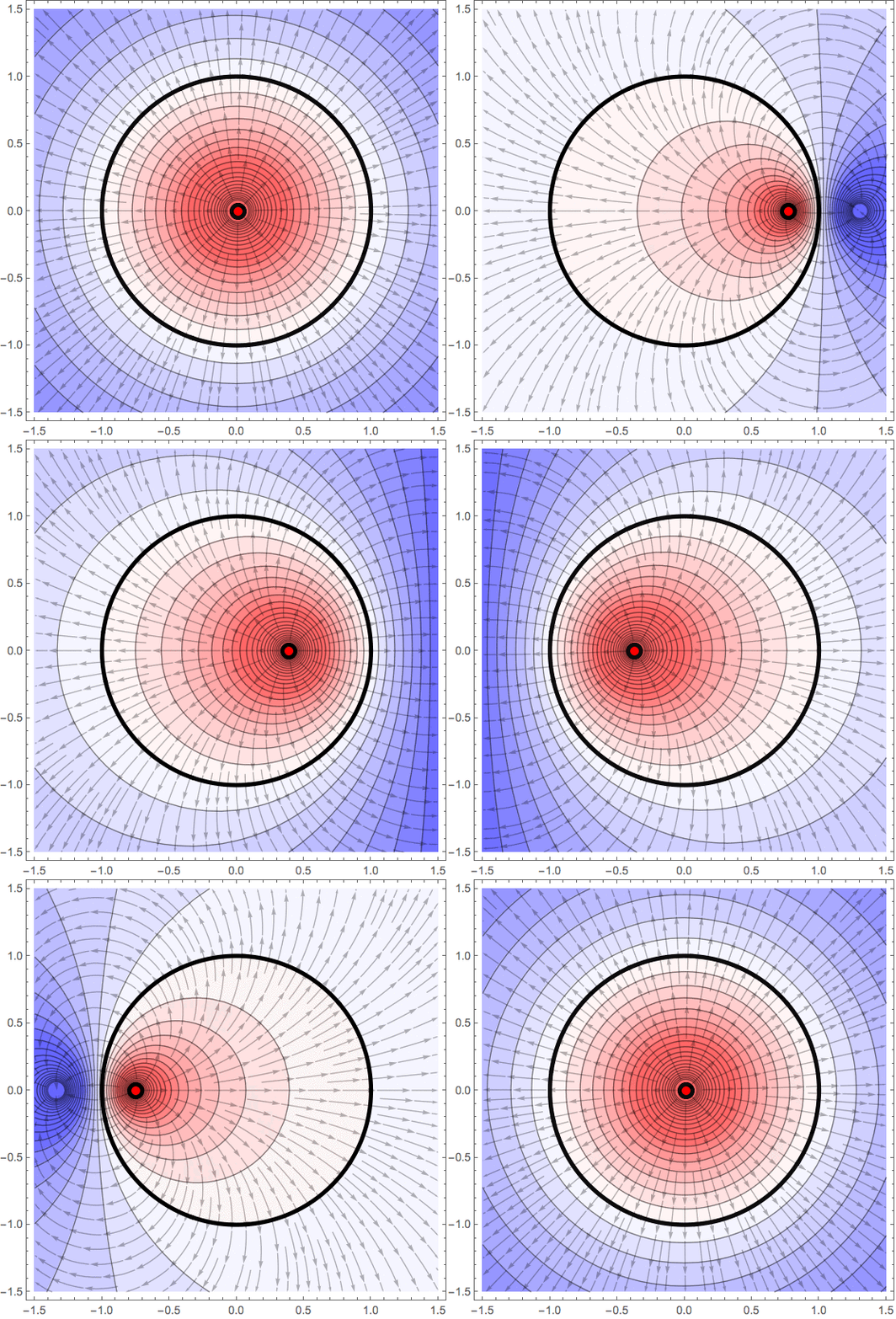
This animation illustrates the electric potential (color gradient) and field (arrows) of a charge (red disc) placed inside a conducting spherical shell (black circle). Note that the shown potential is only physical inside the shell; the exterior potential is an auxiliary construct! The real potential outside the shell is that of a point charge in the center of the shell and does not depend on the actual position of the positive point charge.
Ising criticality
This is a simple simulation (written in C) of a two-dimensional, classical, ferromagnetic Ising model with temperature dropping continuously. It starts in the disordered (paramagnetic) phase and transitions around $t\sim 500$ into the ordered (ferromagnetic) phase with finite-size domains; size and distribution of the latter depend on the quench speed, as described by the Kibble-Zurek mechanism. The transition from paramagnetic to ferromagnetic phase is the paradigmatic example of a phase transition described by spontaneous symmetry breaking.