
Agentic AI
2026 will enter history as the year when developing software became conjuring software overnight, the year in which intelligence became ubiquitous and mathematics changed forever. At this point in time, the ramifications of these developments are hard to fathom. As someone who likes coding, not for the sake of it, but because of the cool stuff code makes happen, I feel like a child in a candy shop: so much to try out! Interesting times, indeed.
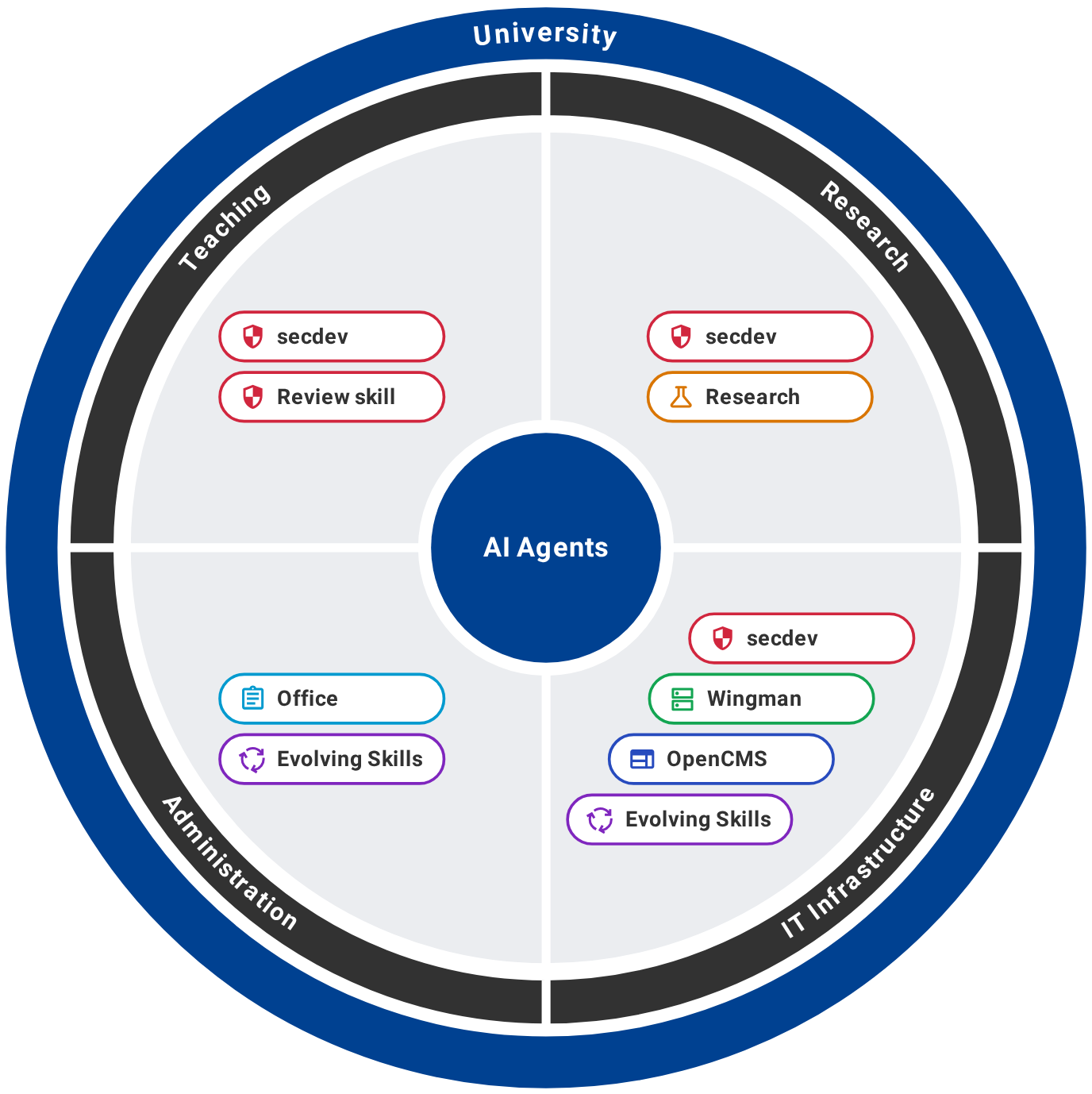
At the Institute for Theoretical Physics III of the University of Stuttgart I do research in theoretical physics, develop lectures, teach students, manage the institute’s IT infrastructure, and fight bureaucracy. Most of this happens in my brain, my computer, or both, and parts can already be automated by AI agents. In 2026, I started exploring potential applications of agentic AI in this context. How can these systems be used to benefit (parts of) my everyday work — without losing control and in compliance with the data protection laws imposed on public institutions like a university? The results are various projects with a focus on safe AI usage, semi-autonomous research, infrastructure management, and a first assault on my nemesis: paperwork.
| Project | Purpose |
|---|---|
| secdev | A rootless container in which AI coding agents can work unsupervised on a specified project, with a full toolchain for the task at hand, but without access to my private data. |
| Research | Scientific container images, a fixed project scaffold, and a written contract to make agents useful co-workers in research. This project aims at automating the read–calculate–code–run–evaluate loop of a researcher in theoretical physics. |
| Wingman | A tool to use agents (powered by local models) for the administration of a heterogeneous fleet of Linux servers — without sacrificing data protection, sovereignty, or security. |
| Office | A multi-host and multi-service framework for using agents to automate repetitive tasks in administration; based on local models so that no data leaves institute hardware. |
| OpenCMS | A complex, learned skill to drive the university’s content management system (OpenCms) to delegate the administration of the institute website to agents. |
| Evolving Skills | A feedback loop and an agent-driven bug tracker to improve and adapt skills over time. |
All of these projects are evolving rapidly to make use of new capabilities that change the playing field constantly. To explain the ideas behind these projects and showcase their features (and shortcomings), I set up a “living documentation” website that you are invited to visit: